
In recent years, the shipping industry has seen a rapid expansion in the number of energy efficiency technologies entering the market.Innovation is not in short supply. On the contrary, the pipeline of solutions has grown significantly, supported by increasing investment, pilot program, and a shared urgency to decarbonize.
The numbers reflect this momentum. Today, there are more than 370 pilot and demonstration projects across shipping, representing a growth of over 350% since 2020. At the same time, studies and industry data continue to point to emissions reduction potentials of up to 40% through existing and emerging technologies.
Despite this, the transition from innovation to impact remains slow. While new solutions continue to emerge, scaling them across fleets remains a persistent challenge. From Njord’s experience working directly with technologies and pilot program, only one out of three well-proven solutions successfully progress towards broader, industry-wide adoption. These are not early-stage concepts, but technologies that have already been tested,validated, and shown to perform. The fact that even these struggle to scale highlights a fundamental issue: the challenge is no longer innovation, but execution.
For many startups and technology suppliers, this gap is where progress stalls. Strong solutions often face similar barriers: limited access to vessels, difficulty generating consistent and comparable insights from operations, and a lack of structured pathways to move from pilot projects to commercial deployment. Without these elements, even promising technologies struggle to build credibility, secure investment, and gain traction in a highly competitive and fragmented market.
As Steen Sander Jacobsen explains:
“There is no shortage of promising technologies in shipping. The challenge is ensuring they can demonstrate consistent results in real operations and translate that into scalable deployment across fleets.”
From a technical perspective, the issue is not proving that a solution can work, but understanding how it behaves across different vessels, routes, and operating conditions in a way that is robust, comparable, and decision ready.
It is within this context that Njord has relaunched its Accelerator, with a clearer and more focused strategy. Rather than positioning it as a broad innovation initiative, the updated Accelerator is designed as a practical framework to support suppliers in moving from validation to real market adoption.
As Federica Pazzini puts it:
“Njord Accelerator creates a structured pathway for suppliers to move from early validation to real-world deployment. We bring together the right partners, vessels, and insights to help technologies prove their value and gain traction”
The relaunch placed a stronger emphasis on enabling suppliers to overcome the barriers that typically limit growth. This includes providing access to pilot vessels, structuring testing under real operating conditions, and generating insights that are both reliable and comparable. It also means supporting the transition from pilot results to commercial rollout, helping suppliers build credible, data-backed business cases that resonate with shipowners and investors.
At a practical level, Njord Accelerator connects technology providers with relevant shipowners and facilitates pilot programs on real vessels. These pilots are designed not only to confirm technical capabilities,but also to assess operational impact and efficiency gains in a structured and transparent way. The output generated through this process has become acritical asset for suppliers, enabling them to demonstrate value, reduce perceived risk, and position their solutions for broader adoption.
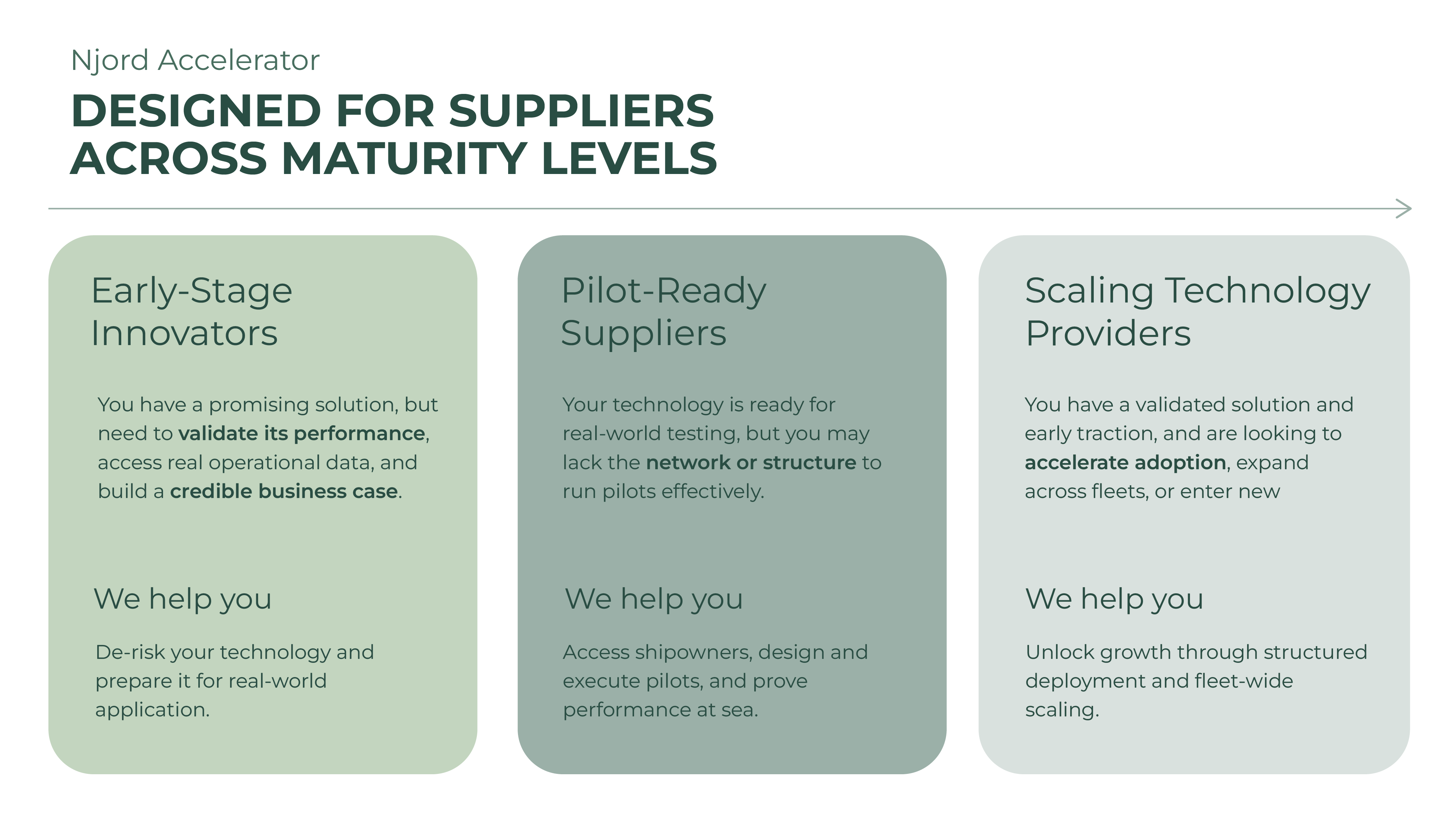
Crucially, the program is designed to support suppliers across different stages of maturity. Early-stage innovators gain access to validation frameworks and operational insights. Pilot-ready companies benefit from structured testing environments and industry connections. More established providers are supported by expanding across fleets and entering new markets. In all cases, the focus remains the same: turning technical potential into commercially viable deployment.
While shipowners remain a key part of the ecosystem, their role within the Accelerator is as partners in validation and deployment. By participating in structured pilots, they gain access to vetted technologies and clearer insight into expected outcomes, while also contributing to the broader scaling of solutions across the industry.
This structured approach also plays a critical role for investors. One of the main challenges in financing maritime technologies is the gap between early validation and scalable deployment. Without consistent evidence and clear routes to market, investment decisions remain difficult.
By structuring pilots, standardizing evaluation methods, and supporting the transition to commercial rollout, Njord Accelerator helps reduce this uncertainty. It provides investors with greater visibility into how technologies perform in real operating conditions, how they translate into measurable value, and how they can scale across fleets.
Ultimately, the relaunch of Njord Accelerator reflects a shift in focus, from showcasing innovation to enabling it to succeed in the market. For suppliers, this means moving beyond validation towards real growth.For investors, it means greater confidence in where to allocate capital. And for the industry, it means creating the conditions required to turn promising technologies into measurable, fleet-wide impact.
Njord Accelerator is designed to support that transition, helping suppliers not only prove their solutions but scale them where it matters most.
Related articles


.svg)

